Fire Escape Inspection Westchester
- Licensed and Insured
- Mon to Fri 8 AM to 6 PM
- Emergency Response Available

Westchester Fire Escape Code Requirements
Every fire escape on a multifamily building in Westchester County falls under the Fire Code of New York State. This guide explains in plain words what the code asks of owners, who has to comply, how often the fire escape must be examined and how each city, town and village enforces it.
- Reviewed by a NYS Licensed Professional Engineer
- Based on the Fire Code of New York State
- Official Sources Cited
What Are the Fire Escape Inspection Requirements in New York?
Under Section 1032.2.2.2 of the Fire Code of New York State, fire escape stairways and balconies must be examined for structural adequacy and safety every five years by a registered design professional or another person the fire code official accepts. The examination confirms they can carry their own dead load plus a live load of at least 100 pounds per square foot, and the inspection report is submitted to the fire code official.
The examination cycle the state code sets for every covered fire escape
A NYS registered design professional signs the examination
The written report goes to the local fire code official
The live load the examination must confirm, on top of the structure’s own weight
What the Fire Code of New York State Says About Fire Escapes
Fire escape rules sit in two places in the Fire Code of New York State. Chapter 10 covers upkeep and the five-year examination, and Chapter 11 sets the design rules for fire escapes on existing buildings. These are the parts that matter most to a Westchester owner.
| Section | What it requires |
|---|---|
| 1032.2.2 Security enclosures | Fences, gates or screening around a fire escape need the fire code official’s approval, cannot block the way to the street and must let firefighters reach the stair from outside. |
| 1032.2.2.1 Maintenance | Fire escape stairways and balconies are kept clear and unobstructed at all times and maintained in good working order. |
| 1032.2.2.2 Examination | Stairways and balconies are examined for structural adequacy and safety every five years by a registered design professional or another person the fire code official accepts, and the report is submitted to the fire code official. |
| 1104.16.1 Existing means of egress | Fire escape stairways are allowed on existing buildings but cannot make up more than half of the required exit capacity. |
| 1104.16.2 Opening protectives | Doors and windows within 10 feet of a fire escape need three-quarter hour fire-rated protection, unless the building is fully sprinklered. |
| 1104.16.4 Access | Access is from a door or window that meets the code, never through another room off a corridor. The landing sits no higher than the floor or sill and no more than 8 inches below the floor or 18 inches below the sill. |
| 1104.16.5 Materials and strength | Components are noncombustible and carry their own dead load plus a live load of at least 100 pounds per square foot, with a top and intermediate handrail on each side. |
| 1104.16.6 Termination | The lowest balcony is no more than 18 feet above the ground, and the stair reaches the ground or ends in a counterbalanced stair that does. An approved ladder can serve where 10 or fewer occupants use the fire escape. |
Fire code officials can still call for an engineer sooner when they find signs of an unsafe fire escape, and some cities add their own written procedures on top of the state code. Yonkers is the best known example in Westchester.
Which Westchester Buildings Need a Fire Escape Inspection?
The examination rule follows the building, not the owner. If the fire escape serves as an exit for a multifamily or mixed-use building, it is covered.
Covered by the Rule
- Apartment buildings with three or more units
- Mixed-use buildings with apartments above stores
- Co-ops, condos and rental buildings alike
- Buildings where the fire escape is a required exit
Usually Outside the Rule
- One and two family houses, even large ones
- Buildings where removal was formally approved
- Fire escapes taken out of exit use with approval
Outside the rule does not mean safe. A rusted fire escape on a two family house can still fail, so an owner should keep it maintained or ask the local building department about approved removal.
How the Five-Year Fire Escape Inspection Cycle Works in Westchester
The five-year examination is the anchor, but a fire escape is looked at more often than that. This is how the cycle runs for most buildings.
Examination and Report
A registered design professional examines the fire escape and the report is filed with the fire code official.
Routine Fire Inspections
Local fire inspectors look at fire escapes during regular fire safety inspections of multiple dwellings, held at least every three years under state rules.
Maintenance Between Cycles
Small items such as loose steps, worn handrails, debris and peeling paint are cited and fixed without waiting for the next examination.
Next Examination Due
Five years after the last one. An inspector who sees danger signs can call for an engineer before then.
What Can Trigger an Earlier Examination
Inspectors order an engineer back before the five years are up when they see signs that the steel or its connections may be failing.
- Missing pieces or parts that have broken away
- Joints bent or swollen by rust
- Loose or missing connections between members
- Weak connections where the fire escape meets the wall
- Damage from a fire, falling debris or a vehicle
What a Fire Escape Inspection Checklist Covers
Westchester inspectors and engineers work from checklists built around the same parts of the fire escape. The Yonkers policy publishes a 26 item checklist, and these are the groups it covers.
Structure
- Stair stringers and treads
- Platforms and supports
- Railings and handrails
- Support legs set on piers
Connections
- Bolts, rivets and welds
- Joints and plates
- Wall anchors and brackets
- Anchor strength confirmed
Corrosion
- Paint and rust protection
- Internal rust in critical joints
- Rust in counterweight boxes
Ladders and Counterbalance
- Drop and fixed ladders
- Counterbalance balance and release
- Smooth drop to grade
Access and Hazards
- Landings free of storage
- No wires or hazards within 10 feet
- Signs posted at access points
Where a Load Test Fits In
A checklist is visual. When strength is in doubt, the engineer proves it with weight. See how fire escape load testing works in Westchester.
Fire Escape Signage and Window Access Rules in Westchester
A fire escape only works if tenants can find it and reach it in the dark. Fire inspectors in Westchester look hard at the window or door that leads onto the landing.
Signs
- A sign reading FIRE ESCAPE at each access point, visible as you approach
- Lit or reflective signs where the hallway is dark
- In Yonkers, a certification tag on the lowest landing that can be read from the ground
Access Windows and Doors
- One simple latch that opens without a key or special knowledge
- No air conditioners, grills, planters or storage on the landing
- Window guards and gates only of a type the fire code official accepts
- Storm windows and screens that do not slow the way out
- Security gates or fences around the fire escape only with the fire code official’s approval
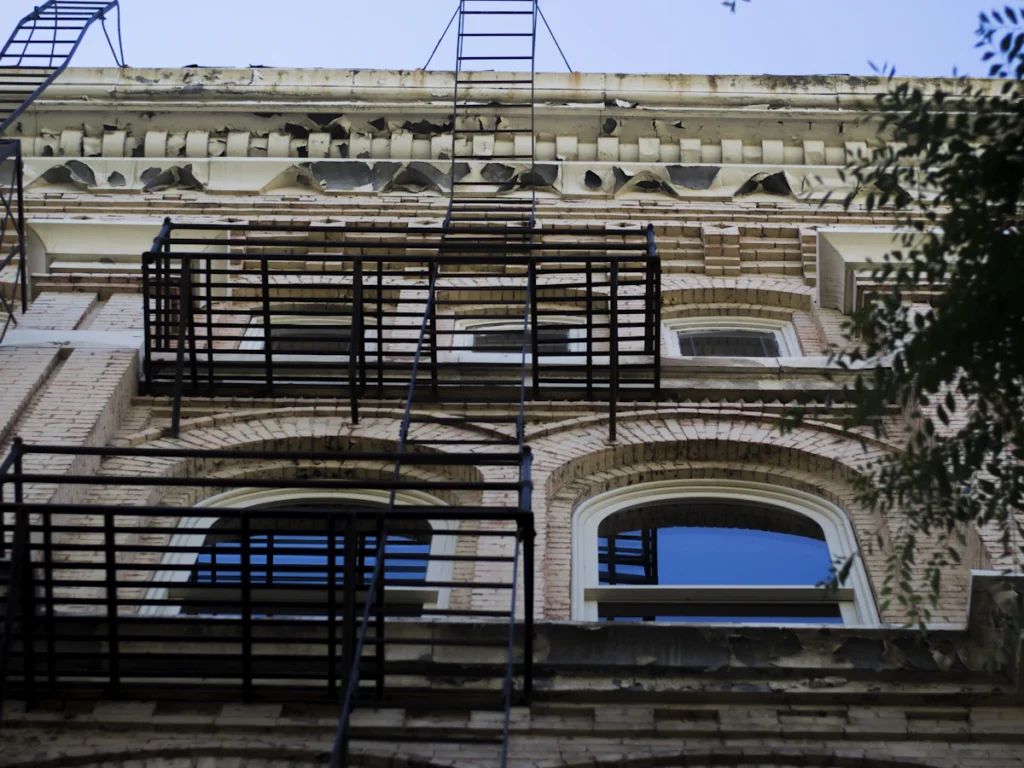
How Fire Escape Code Enforcement Works Across Westchester
New York State makes each city, town and village enforce the fire code inside its own borders. That is why the same fire escape rule can feel different in Yonkers than it does in Ossining or Rye.
| Where the building is | Who usually enforces | What owners notice |
|---|---|---|
| One of the six cities | The city fire department’s fire prevention bureau, working with the building department | Scheduled inspections, written notices with correction dates and re-inspections |
| A village | The village building department or code enforcement officer, often with a fire inspector | A smaller office that knows each building, with structural repairs often needing a village permit |
| A town, outside its villages | The town building department or fire inspector | The same state code, with town permits for structural work |
Yonkers Has Its Own Written Fire Escape Policy
Yonkers publishes a Fire Escape Testing and Maintenance policy. It calls for a load performance test with the five-year certification, a checklist and affidavit from a licensed professional, a permit through the Department of Housing and Buildings for major repairs and a phone report to the fire department within 12 hours when an unsafe condition is found.
Fire Escape Compliance Checklist for Westchester Owners
Most violations come from small things left too long. Work through this list once a season and keep your file ready for the inspector.
Know the date of your last examination and when the next one is due
Keep the last signed report and any affidavit in your building file
Walk the landings and clear anything stored on them
Check that every access window opens with one simple latch
Confirm FIRE ESCAPE signs are posted and readable
Have drop ladders and counterbalance stairs operated and kept free
Fix cited items before the correction date on the notice
Keep photos and invoices for every repair and repaint
Call a professional at the first sign of cracked brick or loose steel
Already holding a notice? See fire escape violation correction. Seeing loose or cracked steel? See fire escape repair in Westchester.
Sources for This Fire Escape Code Guide
- Fire Code of New York State, Chapter 10, Section 1032.2.2 Fire Escapes and Chapter 11, Section 1104.16 Fire Escape Stairways, as adopted by the NYS Department of State
- City of Yonkers Fire Escape Testing and Maintenance policy
- NYS Department of State guide to the Uniform Fire Prevention and Building Code for local officials
- Westchester County list of cities, towns and villages
How This Guide Was Written
This guide was written by the Fire Escape Inspection Westchester team and reviewed by a New York State licensed professional engineer who inspects fire escapes in the county. It explains the code in plain words and is not legal advice. Your local fire code official has the final word on how the code applies to your building.
Fire Escape Code FAQs for Westchester Owners
Short answers to the code questions owners and buyers ask most.
Which section of the New York fire code covers fire escapes?
Fire escapes are covered in two places in the Fire Code of New York State. Section 1032.2.2 in Chapter 10 covers upkeep and the five-year examination, and Section 1104.16 in Chapter 11 covers design rules such as access, strength and how the stair reaches the ground.
Does the fire code cover fire escapes on the rear or side of a building?
Yes. The code does not care which wall a fire escape hangs on. Any fire escape that serves as part of the exit system is examined and maintained the same way, including rear fire escapes reached through yards and alleys.
Can a fire escape count as the only exit from an apartment?
No. The code allows fire escape stairs on existing buildings only as part of the exit system, and they cannot make up more than half of the required exit capacity. Interior stairs carry the rest.
Can I build a new fire escape on my building?
Fire escapes are permitted on existing buildings, while new construction relies on enclosed stairs instead. Replacing an existing fire escape in kind is a different matter, and it is planned with a licensed engineer and the local building department.
Who is responsible for the fire escape, the owner or the tenant?
The owner of record is responsible for the fire escape and its report. Tenants are expected to keep landings clear, and the owner should give written notice when items need to come off.
What happens if I miss the five-year examination?
The fire code official can cite the building and set a date for the examination and report. An overdue fire escape also draws closer attention at the next fire inspection, so booking early is the simpler path.
Do fire escape stairs have to reach the ground?
The code says the lowest balcony can be no more than 18 feet above the ground, and the stair must reach the ground or end in a counterbalanced stair that swings down to it. An approved fire escape ladder can serve as the end point where the fire escape serves 10 or fewer occupants.
Do window guards or gates have to come off a fire escape window?
Not always. A guard or gate on a fire escape window must be a type the fire code official accepts, which means it opens from inside without a key, tool or special knowledge. A fixed guard that blocks the window is a common citation.
Get Your Westchester Fire Escape Into Compliance
Not sure where your building stands under the code? Call us with the address and we will tell you when the next examination is due, what an inspector is likely to flag and how to get ahead of it. Monday to Friday, 8 AM to 6 PM.